Categories / Strength & resistance
Pull-Up Progression
Structured plan from assisted to full pull-ups.
How to start
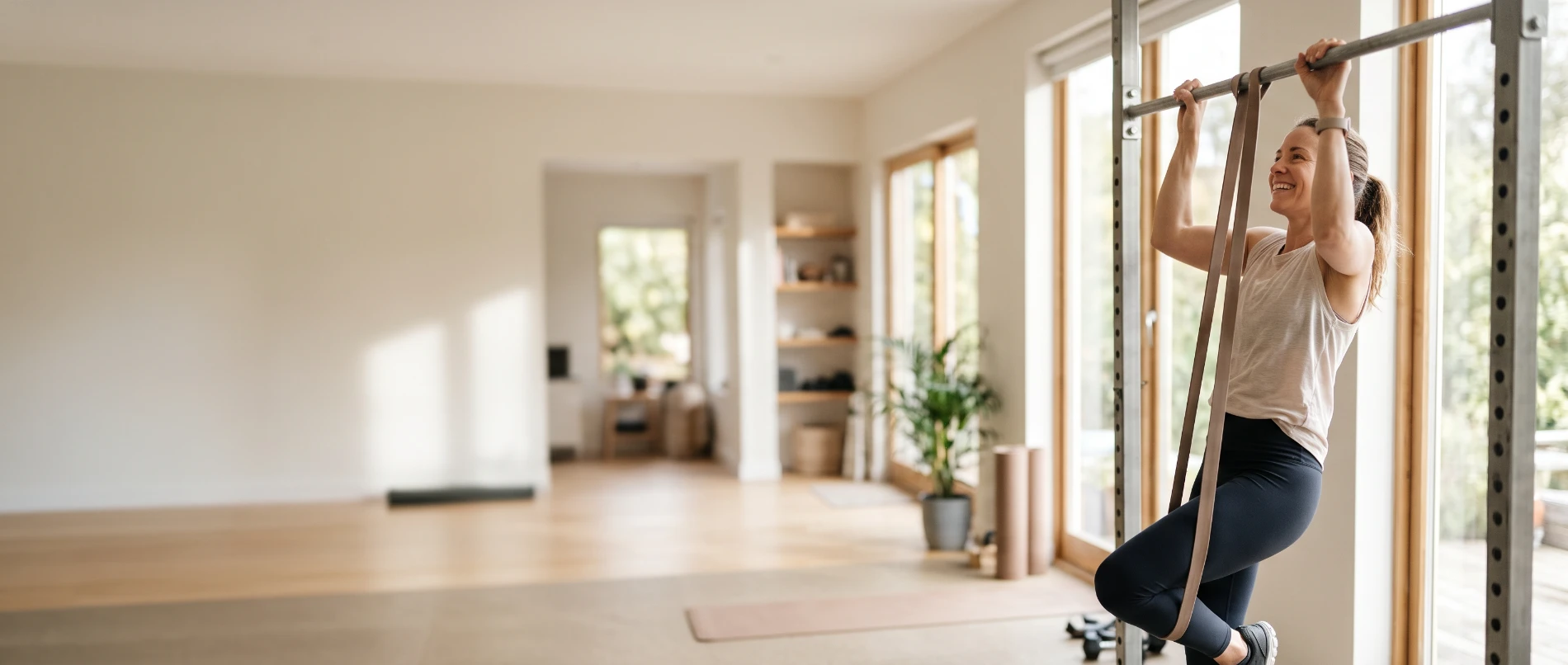
Use a sturdy bar and start with assisted pull-ups using a band or a chair, or do slow lowering (negatives) from the top. Include dead hangs to build grip.
How to progress
Reduce the assistance, then add reps. Train three days a week, with rest days between. A first full pull-up often takes 8 to 12 weeks.
What the evidence says
Evidence: limited
We found no studies of pull-up progressions in particular. Pull-ups are a muscle-strengthening exercise, so the general evidence applies: Muscle-strengthening activities were linked to 10% to 17% lower risk of death from any cause, heart disease, cancer and diabetes in a 2022 pooled analysis of 16 cohort studies. The biggest drop (about 10% to 20%) came at roughly 30 to 60 minutes a week, and more did not clearly add more benefit. These are observational studies.
Take care: Warm up your shoulders and elbows first. Avoid swinging and stop with sharp shoulder or elbow pain.
Sources
12-week starter plan
Three short sessions a week. Start with the easiest version that lets you do a few controlled reps.
Tick each week as you finish it; your ticks are saved on this device only. Repeat a week if it felt hard. Weeks 4, 8 and 12 hold steady so you can settle. This is a general plan, not medical advice.
Add reminders to your calendar
Pick your days and time. You will download a calendar file that adds 12 weeks of reminders to Google, Apple or Outlook calendar.
Calories and weekly minutes
Enter your details for a rough estimate. Based on about 4 METs (Pull-up practice and rows (estimated)). Real figures vary by 20% or more between people.
Tips and common mistakes
Tips
- Start each rep with your shoulder blades pulled down.
- Lower slowly: negatives build strength fast.
- Use a resistance band to assist, and use lighter bands over time.
Common mistakes
- Kipping or swinging.
- Doing too many reps with poor form.
- Neglecting your pulling muscles in the back.
Kit and cost
Low cost Approximate UK prices.
- A doorway or wall pull-up bar (about £15 to £40)
- Resistance bands for assistance (about £10 to £25)
- A sturdy chair
Frequently asked questions
Why can I not do a pull-up?
It takes a lot of upper-body strength. Assisted versions and negatives are a good way to build it.
How long until my first pull-up?
Often 8 to 12 weeks, depending on your starting strength and body weight.
Do I need a bar?
Yes, or a high sturdy rail. Table rows build pulling strength without one.
Good for: Strength Muscle size
Compare with similar options
| Pull-Up Progression | Bodyweight Calisthenics | 100 Push-Ups Plan | Dumbbell Home Workouts | |
|---|---|---|---|---|
| Typical session | 20 min × 3/wk | 40 min × 3/wk | 20 min × 3/wk | 40 min × 3/wk |
| Effort | ●●●○○ | ●●●○○ | ●●●○○ | ●●●○○ |
| Cost | Low cost | Free | Free | Low cost |
| Equipment | Basic kit | No equipment | No equipment | Some equipment |
| Impact | Low impact | Low impact | Low impact | Low impact |
| Fitness needed | Some fitness | Any level | Any level | Any level |
| Evidence | limited | moderate | limited | moderate |