ExerciseExplorer
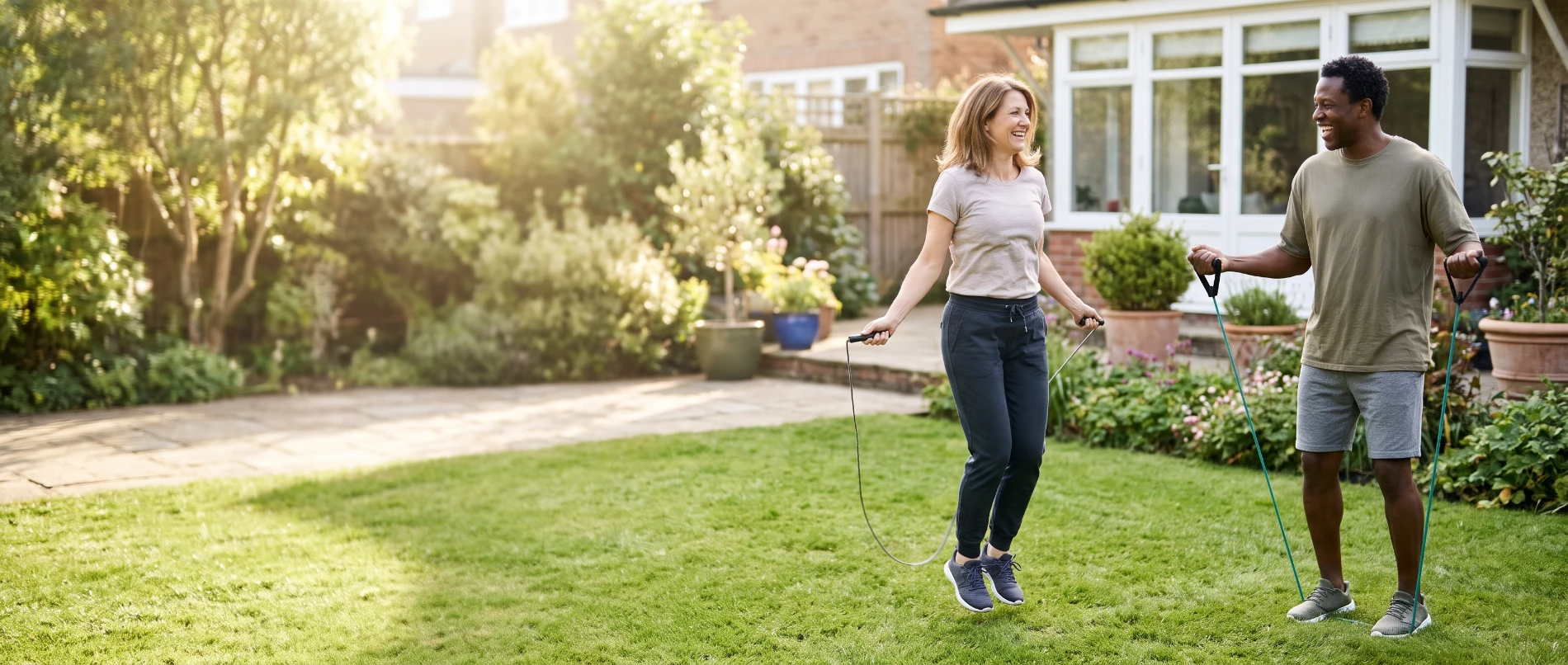
A smiling man and woman exercising at home with resistance bands and a skipping rope

Get-fit guides / Cheap exercise

Cheap exercise

By the Exercise Explorer team. Last updated 13 November 2026.

Most of what works is cheap. A pair of supportive shoes, a set of resistance bands and some free time go a long way. These are the low-cost options we rate well, and what is worth paying for.

Read this first. This is general information, not medical advice. If you have a health condition, build up gradually and check with your GP if unsure.

The short answer

  • Walking and bodyweight exercises are free, and strength work counts whatever you use. A 2022 pooled analysis linked muscle-strengthening activity to lower risk of death and long-term conditions (observational).
  • Resistance bands and a skipping rope cost little and last a long time.
  • A pay-as-you-go swim or a second-hand bike can be good value.
  • Supportive footwear is the one item worth paying for.

The best cheap ways to get fit

Walking

Daily Walking

Steady walks built into the day; the easiest place to start.
30 min × 5/wkEffort ●○○○○Free
Strength & resistance

Resistance Band Training

Full-body workouts with elastic bands.

30 min × 3/wkEffort ●●○○○Low cost
Strength & resistance

Bodyweight Calisthenics

Push-ups, squats, pull-ups and dips using body weight.

40 min × 3/wkEffort ●●●○○Free
Swimming & water

Lap Swimming

Pool lengths using one or more strokes.

40 min × 3/wkEffort ●●●○○Low cost
Cycling

Commuting by Bike

Replace short trips with cycling.

30 min × 5/wkEffort ●●○○○Low cost
Strength & resistance

Dumbbell Home Workouts

Full-body routines with a pair of dumbbells.

40 min × 3/wkEffort ●●●○○Low cost
Functional & athletic

Jump Rope

Skipping for coordination and cardio.

15 min × 4/wkEffort ●●●●○Free
Digital & at-home

Home Exercise Videos

Follow-along YouTube or DVD classes.

30 min × 3/wkEffort ●●●○○Free

How each one helps

Evidence at a glance How much good research supports each option

StrongModerateLimited

  1. 1
    Daily WalkingStrong evidence

    Free, and needs only decent shoes.

    30 min × 5/wkEffort ●○○○○Free
  2. 2
    Resistance Band TrainingModerate evidence

    A set of bands costs a few pounds and covers full-body strength.

    30 min × 3/wkEffort ●●○○○Low cost
  3. 3
    Bodyweight CalisthenicsModerate evidence

    Free, and scalable.

    40 min × 3/wkEffort ●●●○○Free
  4. 4
    Lap SwimmingModerate evidence

    Pay per swim at a local pool, often with concessions.

    40 min × 3/wkEffort ●●●○○Low cost
  5. 5
    Commuting by BikeModerate evidence

    A second-hand bike can replace transport costs.

    30 min × 5/wkEffort ●●○○○Low cost
  6. 6
    Dumbbell Home WorkoutsModerate evidence

    A single pair of adjustable or second-hand dumbbells is enough.

    40 min × 3/wkEffort ●●●○○Low cost
  7. 7
    Jump RopeLimited evidence

    A cheap, portable cardio tool. It is high-impact, so build up slowly.

    15 min × 4/wkEffort ●●●●○Free
  8. 8
    Home Exercise VideosLimited evidence

    Free or low-cost follow-along sessions.

    30 min × 3/wkEffort ●●●○○Free

Find my exercise Browse all

What to watch out for

  • Buying expensive kit before you know you will use it.
  • Gimmicks that promise fast results. We found no trials we had read in full of most of them.
  • Cheap, unsupportive running shoes if you walk or run a lot.
  • Long gym contracts you are unsure you will use.
  • Skipping a warm-up because there is no coach.

A budget-friendly week of exercise

This is an example to adapt, not a prescription. If a day feels too much, do less.

  1. Day1A 15-minute walk.Walking
  2. Day210 minutes of bodyweight or band exercises at home.Yoga and floor exercises
  3. Day3A 20-minute walk.Walking
  4. Day4Rest.Rest day
  1. Day5Repeat Day 2.Yoga and floor exercises
  2. Day6A swim, a bike ride, or a longer walk.Swimming or water walking
  3. Day7Rest, or gardening and housework.Rest day
  4. My notes: what did you do, and how did it feel?

When to see a doctor

Stop exercising and get medical advice if any of these apply to you.

Get urgent help now

  • Chest pain or tightness
  • Severe breathlessness, or fainting

Call 999 or go to A&E. Do not wait for a GP appointment.

Speak to a GP or call NHS 111 if you have

  • Dizziness or palpitations during exercise.
  • Pain that is sharp, or worse after exercise.
  • Health conditions or medicines and you are unsure what is suitable.

What the research says

The WHO 2020 guidelines recommend 150 to 300 minutes of moderate activity a week plus muscle-strengthening on at least two days. None of this requires special equipment.

A 2022 pooled analysis of 16 cohort studies linked muscle-strengthening activity to 10% to 17% lower risk of death from any cause, heart disease, cancer and diabetes. Bodyweight exercises count, though most of the studies did not break them out separately. These are observational studies.

A 2025 Lancet Public Health dose-response analysis linked about 7,000 steps a day to roughly 47% lower all-cause mortality compared with 2,000 steps, with smaller gains beyond that. This is observational.

We found no trials we had read in full comparing cheap with expensive equipment.

Full references are listed under Sources below. Evidence ratings are our own plain-English summary of the research we found, not a medical opinion.

Frequently asked questions

What is the cheapest way to get fit?

Walking and bodyweight exercises cost nothing. Resistance bands add cheap, versatile strength work.

What equipment is worth buying?

Supportive shoes, a set of resistance bands, and perhaps a skipping rope or a pair of dumbbells.

Is a gym membership worth it?

Only if you will use it. Many people get what they need at home or outdoors for much less.

Can I build strength cheaply?

Yes. Bodyweight exercises and resistance bands can build strength, especially for beginners.

Is cycling a cheap way to exercise?

A second-hand bike can be good value, especially if it replaces other transport costs.

Are budget workout gadgets any good?

We found no trials we had read in full of most gadgets. Basic equipment you use regularly beats gadgets you do not.

When should I see a doctor?

Get urgent help for chest pain, severe breathlessness or fainting. See a GP for dizziness, palpitations or pain that does not settle.

Sources

  1. World Health Organization 2020 guidelines on physical activity and sedentary behaviour. British Journal of Sports Medicine, 2020. doi.org/10.1136/bjsports-2020-102955
  2. Muscle-strengthening activities are associated with lower risk and mortality in major non-communicable diseases: a systematic review and meta-analysis of cohort studies. British Journal of Sports Medicine, 2022. doi.org/10.1136/bjsports-2021-105061
  3. Daily steps and health outcomes in adults: a systematic review and dose-response meta-analysis. The Lancet Public Health, 2025. doi.org/10.1016/S2468-2667(25)00164-1

Related guides