ExerciseExplorer
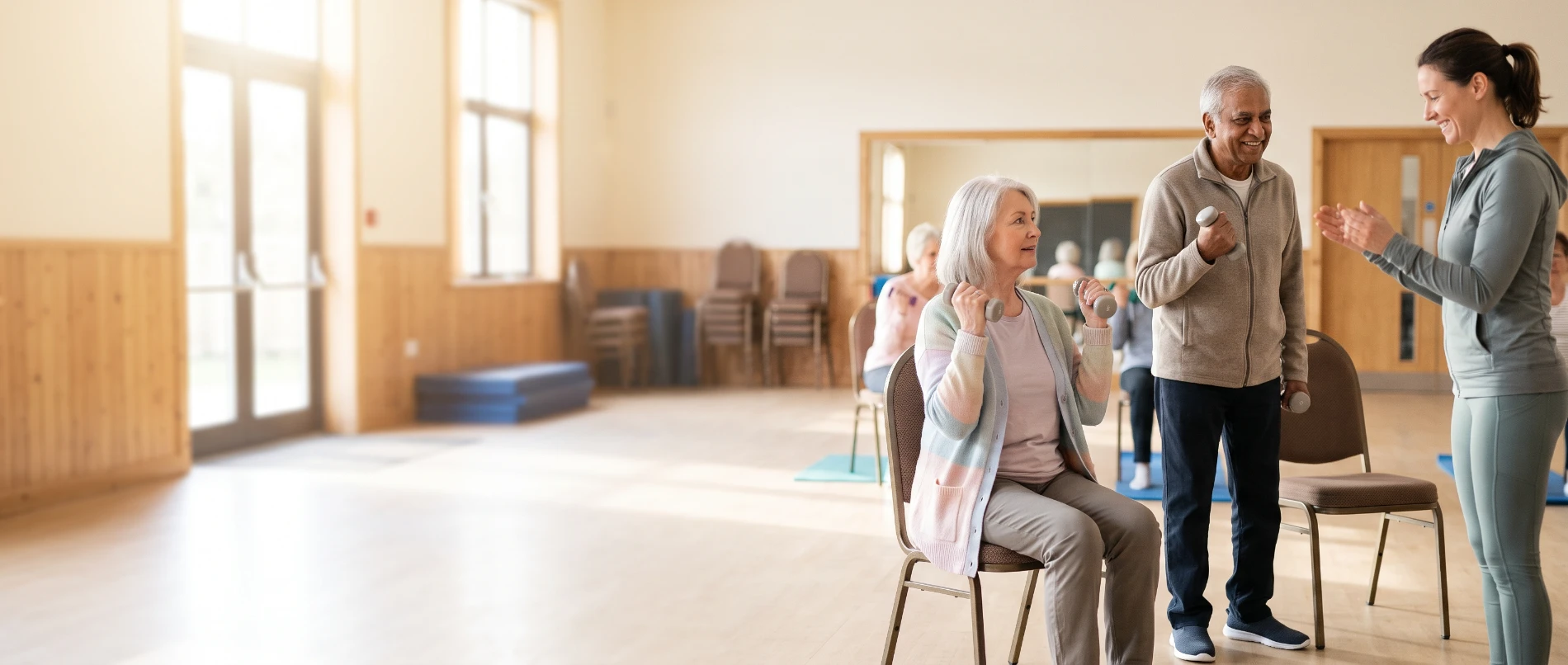
A smiling woman and man in their seventies doing seated exercises in a bright community hall

Get-fit guides / Exercise for over 70s

Exercise for over 70s

By the Exercise Explorer team. Last updated 13 November 2026.

In your seventies, strength and balance matter as much as stamina, because they help you stay independent and reduce the risk of falls. These are the options we rate well, many of which can be done sitting or holding a chair.

Read this first. This is general information, not medical advice. If you have a long-term condition, have had a fall, or take medicines that can cause dizziness, talk to your GP, practice nurse or a physiotherapist before starting.

The short answer

  • Balance and strength work on three or more days a week is part of the WHO guidance for people aged 65 and over.
  • A 2026 pooled analysis of 14 trials found exercise gave modest improvements in balance in older adults with long-term conditions. The clinical importance was uncertain.
  • Gentle options such as walking, chair exercises, tai chi and water exercise are good starting points.
  • Do balance exercises next to a sturdy surface, and stop if you feel dizzy or unwell.

The best exercises for people over 70

Walking

Daily Walking

Steady walks built into the day; the easiest place to start.
30 min × 5/wkEffort ●○○○○Free
Mobility, rehab & life stages

Balance Training

Single-leg stands, heel-to-toe walking and beams.

10 min × 5/wkEffort ●○○○○Free
Mobility, rehab & life stages

Strength and Balance Class

Community class for older adults, often NHS-linked.

60 min × 2/wkEffort ●●○○○Low cost
Yoga, Pilates & mind-body

Tai Chi

Slow, flowing movements for balance and calm.

45 min × 3/wkEffort ●○○○○Low cost
Strength & resistance

Resistance Band Training

Full-body workouts with elastic bands.

30 min × 3/wkEffort ●●○○○Low cost
Swimming & water

Aqua Aerobics

Group exercise to music in a pool.

45 min × 2/wkEffort ●●○○○Low cost
Mobility, rehab & life stages

Chair Exercises

Seated exercises for strength and circulation.

20 min × 4/wkEffort ●○○○○Free
Mobility, rehab & life stages

Otago Exercise Programme

Home programme proven to reduce falls in older adults.

30 min × 3/wkEffort ●○○○○Free
Yoga, Pilates & mind-body

Chair Yoga

Seated and supported yoga for limited mobility.

30 min × 3/wkEffort ●○○○○Low cost

How each one helps

Evidence at a glance How much good research supports each option

StrongModerateLimited

  1. 1
    Daily WalkingStrong evidence

    Short, regular walks. Use a stick or rail if you need to.

    30 min × 5/wkEffort ●○○○○Free
  2. 2
    Balance TrainingModerate evidence

    Simple balance practice holding a worktop, such as standing on one leg.

    10 min × 5/wkEffort ●○○○○Free
  3. 3

    A class gives instruction, safety and company.

    60 min × 2/wkEffort ●●○○○Low cost
  4. 4
    Tai ChiModerate evidence

    Slow, controlled movement that can help balance.

    45 min × 3/wkEffort ●○○○○Low cost
  5. 5
    Resistance Band TrainingModerate evidence

    Light strength work that can be done seated.

    30 min × 3/wkEffort ●●○○○Low cost
  6. 6
    Aqua AerobicsModerate evidence

    Water supports the body, which lowers the risk of falling.

    45 min × 2/wkEffort ●●○○○Low cost
  7. 7
    Chair ExercisesLimited evidence

    Seated exercise that is safe when balance or strength is limited.

    20 min × 4/wkEffort ●○○○○Free
  8. 8
    Otago Exercise ProgrammeLimited evidence

    A strength and balance programme widely used for fall prevention. Best done with guidance.

    30 min × 3/wkEffort ●○○○○Free
  9. 9
    Chair YogaLimited evidence

    Gentle stretching and breathing from a chair.

    30 min × 3/wkEffort ●○○○○Low cost

Find my exercise Browse all

What to avoid or go slowly with

  • Exercises that need quick direction changes or uneven ground until your balance is good.
  • Standing up quickly from a seat or floor if you get dizzy.
  • Exercising alone if you are at risk of falls and unsure of your balance. Have someone nearby or a sturdy support.
  • Holding your breath or straining.
  • Pushing through pain. Mild muscle ache is normal; sharp pain is not.

How to start exercising after 70: a gentle first week

This is an example to adapt, not a prescription. If a day feels too much, do less.

  1. Day1A 10-minute walk, or a seated march if walking is hard.Walking
  2. Day210 minutes of seated strength work, such as leg extensions and arm raises.Yoga and floor exercises
  3. Day3A 10-minute walk.Walking
  4. Day4Rest.Rest day
  1. Day55 minutes of balance practice holding a worktop, plus seated strength work.Yoga and floor exercises
  2. Day6A 10 to 15-minute walk, or water exercise.Swimming or water walking
  3. Day7Rest. If the week felt fine, add a few minutes next week.Rest day
  4. My notes: how did you feel, and did you feel steady?

When to see a doctor

Stop exercising and get medical advice if any of these apply to you.

Get urgent help now

  • Chest pain or tightness
  • Severe breathlessness, or fainting
  • A fall with severe pain, a head injury, or inability to get up or bear weight

Call 999 or go to A&E. Do not wait for a GP appointment.

Speak to a GP or call NHS 111 if you have

  • Dizziness, especially when standing up.
  • Falls, near-falls or feeling unsteady more than before.
  • Unusual breathlessness, palpitations or swollen ankles.
  • New joint or back pain that does not ease.

What the research says

The WHO 2020 guidelines recommend that adults aged 65 and over do multicomponent physical activity that emphasises balance and strength training on three or more days a week, and note that some activity is better than none.

A 2026 pooled analysis of 14 trials (857 community-dwelling older adults with long-term conditions) found that exercise improved one-leg stance time by about 5 seconds and the Timed Up and Go test by about 0.8 seconds, with larger gains in people with musculoskeletal conditions and with balance training. The gains were modest and their clinical importance was uncertain.

We found no trials of chair exercises or the Otago programme that we had read in full, so they are included because they are widely used and low risk, not because of results we reviewed.

Full references are listed under Sources below. Evidence ratings are our own plain-English summary of the research we found, not a medical opinion.

Frequently asked questions

What is the best exercise for over 70s?

A mix of walking or other gentle aerobic activity with strength and balance work. Choose what feels safe and that you enjoy.

How much exercise should a 70 year old do?

The WHO suggests 150 to 300 minutes of moderate activity a week plus balance and strength work on three or more days, but any activity is better than none.

Are chair exercises worthwhile?

They are a safe way to start if balance or strength is limited. We did not find trials we had read in full, but they are low risk and widely used.

Can exercise prevent falls?

Balance and strength exercise is widely used to reduce fall risk. A 2026 pooled analysis found modest gains in balance, though it is not a guarantee.

Is it safe to lift weights at 70?

Light resistance is widely recommended. Use good form, breathe steadily and ask a GP or physio if you have heart, blood pressure or bone concerns.

What if I am worried about falling?

Practise balance next to a sturdy surface, consider a class, and ask your GP about a falls assessment.

When should I see a doctor?

Get urgent help for chest pain, severe breathlessness, fainting, or a fall with severe pain. See a GP for dizziness, repeated falls or unusual breathlessness.

Sources

  1. World Health Organization 2020 guidelines on physical activity and sedentary behaviour. British Journal of Sports Medicine, 2020. doi.org/10.1136/bjsports-2020-102955
  2. Effects of exercise therapy on balance, functional performance, and fall-related outcomes in community-dwelling older adults with chronic conditions: a systematic review and meta-analysis. Frontiers in Immunology, 2026. doi.org/10.3389/fimmu.2026.1918701
  3. Muscle-strengthening activities are associated with lower risk and mortality in major non-communicable diseases: a systematic review and meta-analysis of cohort studies. British Journal of Sports Medicine, 2022. doi.org/10.1136/bjsports-2021-105061

Related guides