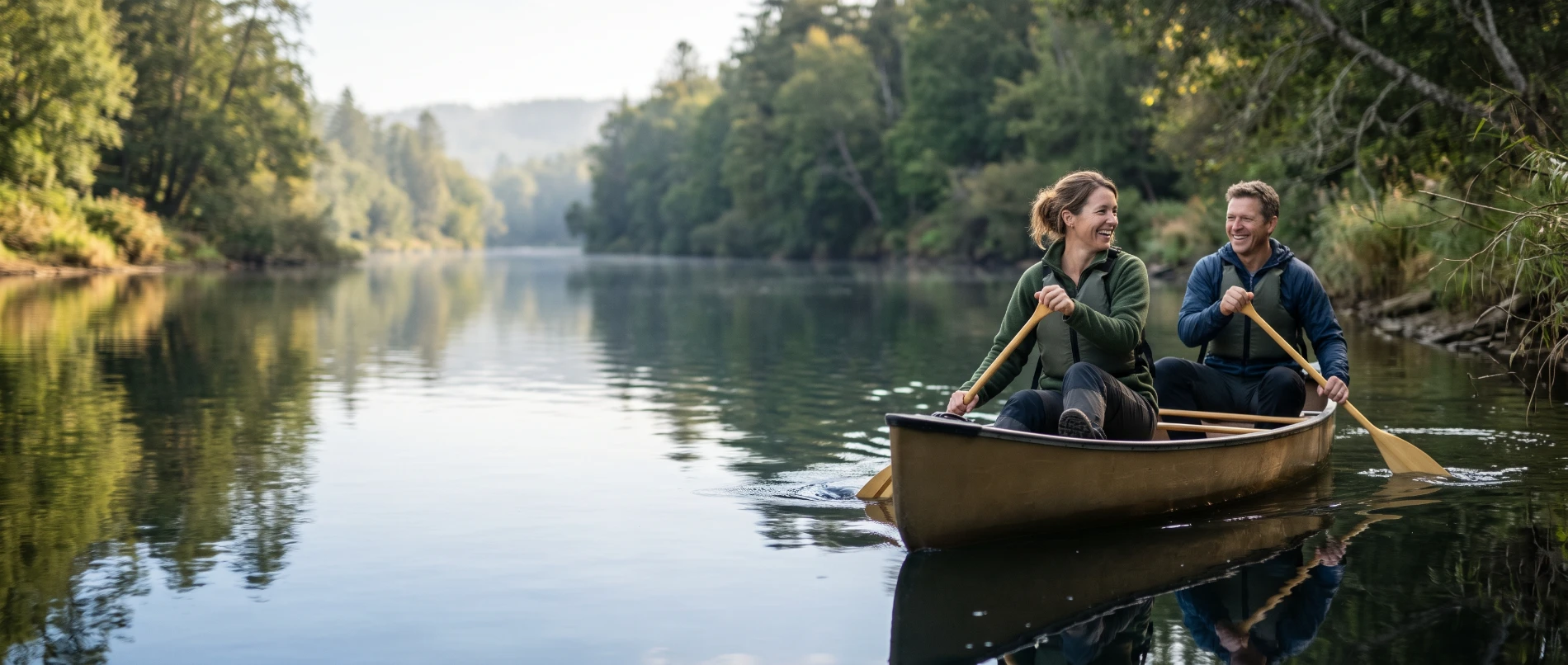
Kayaking and Canoeing
Paddling on rivers, lakes or sea.
How to start
Take a taster session with a club or centre, who provide boats, paddles and buoyancy aids. Learn basic strokes and how to get back in after a capsize.
How to progress
Paddle for longer, try rivers, lakes and the sea with a club, and build skills with courses.
What the evidence says
Evidence: limited
We found no good trials of kayaking and canoeing for health. Paddling works the arms, shoulders, back and core, and is easy to do at your own pace. It is also a good way to spend time outdoors.
Take care: Always wear a buoyancy aid. Learn how to recover from a capsize and check the weather, tides and water levels. Go with others, especially on moving water or the sea.
12-week starter plan
Join a club or take lessons. Paddle regularly on calm water first.
Tick each week as you finish it; your ticks are saved on this device only. Repeat a week if it felt hard. Weeks 4, 8 and 12 hold steady so you can settle. This is a general plan, not medical advice.
Add reminders to your calendar
Pick your days and time. You will download a calendar file that adds 12 weeks of reminders to Google, Apple or Outlook calendar.
Calories and weekly minutes
Enter your details for a rough estimate. Based on about 5 METs (Paddling a kayak at a moderate effort (estimated)). Real figures vary by 20% or more between people.
Tips and common mistakes
Tips
- Use your torso to power the stroke, not just your arms.
- Sit up tall with your feet on the pegs.
- Always wear a buoyancy aid.
Common mistakes
- Paddling on moving water without training.
- Using only the arms.
- Not checking the weather and tides.
Kit and cost
Moderate Approximate UK prices.
- Club or centre boat hire (about £15 to £30 a session) or your own boat (about £300 to £1,000)
- Buoyancy aid, paddle and spray deck (about £80 to £200)
- Warm layers that dry quickly
Frequently asked questions
What is the difference between a kayak and a canoe?
In a kayak you sit with your legs forward and use a double-bladed paddle. In a canoe you kneel or sit and use a single-bladed paddle.
Do I need to swim?
You should be comfortable in water, and always wear a buoyancy aid.
Is it good exercise?
Yes, particularly for the upper body and core. Specific health research is limited.
Good for: Heart & fitness Strength Fun & social
Compare with similar options
| Kayaking and Canoeing | Dragon Boat Racing | Wild (Open-Water) Swimming | Surfing | |
|---|---|---|---|---|
| Typical session | 90 min × 1/wk | 60 min × 2/wk | 30 min × 2/wk | 90 min × 2/wk |
| Effort | ●●●○○ | ●●●○○ | ●●●○○ | ●●●○○ |
| Cost | Moderate cost | Low cost | Low cost | Moderate cost |
| Equipment | Specialist kit | Some equipment | Basic kit | Specialist kit |
| Impact | Low impact | Low impact | Low impact | Low impact |
| Fitness needed | Some fitness | Some fitness | Some fitness | Moderate fitness |
| Evidence | limited | limited | limited | limited |