Featured in: Exercise for osteoporosis, Exercise for over 60s, Exercise for over 50s
Nordic Walking
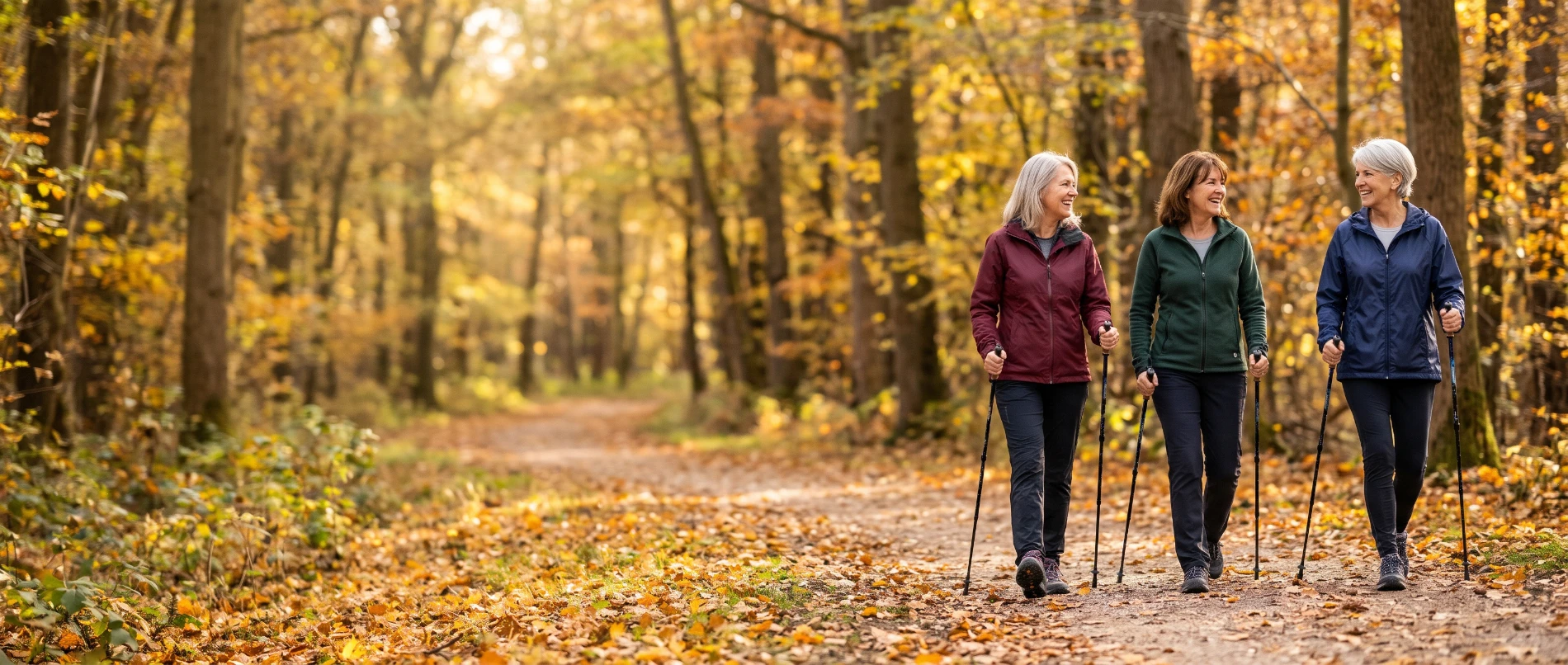
Walking with poles to work arms, shoulders and core.
How to start
Take a taster class or short course to learn the pole technique, then walk 30-45 minutes.
How to progress
Increase pace or add gentle hills once the technique feels natural.
What the evidence says
Evidence: moderate
A 2013 systematic review found benefits over walking without poles for heart rate, oxygen use and quality of life. Other reviews show small gains for balance and flexibility in older adults, and no clear advantage for pain or fatigue.
Take care: Learn the technique first; poor technique can strain shoulders and neck.
Sources
12-week starter plan
Learn the technique in a class or from a coach first. Then build time and pace gradually.
Tick each week as you finish it; your ticks are saved on this device only. Repeat a week if it felt hard. Weeks 4, 8 and 12 hold steady so you can settle. This is a general plan, not medical advice.
Add reminders to your calendar
Pick your days and time. You will download a calendar file that adds 12 weeks of reminders to Google, Apple or Outlook calendar.
Calories and weekly minutes
Enter your details for a rough estimate. Based on about 5.5 METs (Walking with poles at a moderate pace). Real figures vary by 20% or more between people.
Tips and common mistakes
Tips
- Take a taster class or short course: technique makes a big difference.
- Let the poles trail behind you and push off with each step.
- Choose poles that reach your elbow when you stand holding them upright.
Common mistakes
- Using ordinary hiking poles, which are not designed for the push-off.
- Planting the poles in front like a stick.
- Gripping too tightly: the strap should do the work.
Kit and cost
Low to moderate Approximate UK prices.
- A pair of Nordic walking poles (about £40 to £120)
- Walking shoes with some cushioning
- Optional: a course or club session (about £5 to £15 a session)
Frequently asked questions
What is the difference between Nordic walking and hiking with poles?
Nordic walking poles have a strap and a specific push-off technique that works the arms and shoulders as well as the legs. Hiking poles are mainly for balance and support.
Is Nordic walking better than ordinary walking?
Some reviews find small benefits for heart rate, fitness and quality of life, and for balance in older adults. Others find no clear advantage for pain or fatigue.
Do I need lessons?
A short lesson helps you get the technique right and avoid strain. Many local clubs offer taster sessions.
Is it good for people with sore knees?
Poles can take a little load off the legs and some people find it more comfortable. Speak to a physiotherapist if you have a specific joint problem.
Good for: Heart & fitness Weight loss Strength Back & posture
Compare with similar options
| Nordic Walking | Brisk Walking | Interval Walking (Japanese) | Incline Treadmill Walking | |
|---|---|---|---|---|
| Typical session | 45 min × 3/wk | 30 min × 5/wk | 30 min × 4/wk | 30 min × 4/wk |
| Effort | ●●○○○ | ●●○○○ | ●●○○○ | ●●○○○ |
| Cost | Low cost | Free | Free | Moderate cost |
| Equipment | Basic kit | No equipment | No equipment | Some equipment |
| Impact | Low impact | Low impact | Low impact | Low impact |
| Fitness needed | Some fitness | Some fitness | Some fitness | Moderate fitness |
| Evidence | moderate | strong | moderate | limited |